
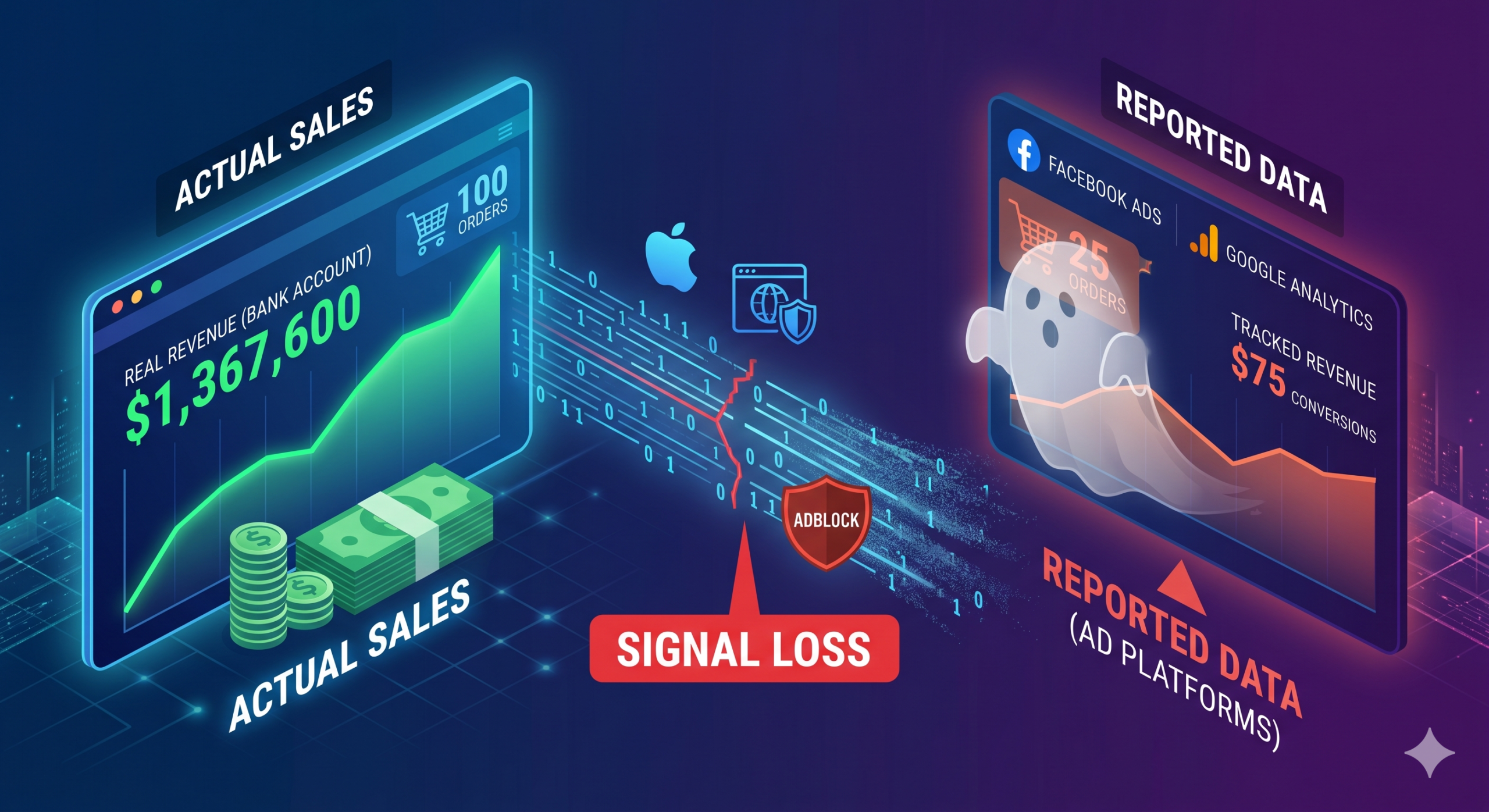
The “Phantom” Revenue Problem
Imagine this scenario: You open your Shopify or Magento dashboard and see 100 orders for the week. Your bank account confirms the revenue is there.
Then, you open your Facebook Ads Manager or Google Analytics 4 (GA4) to see which campaigns drove those sales. But the platforms only report 75 conversions.
Where did the other 25 orders go?
They didn’t disappear from your bank account, but they did disappear from your data ecosystem. This is “Signal Loss,” and for e-commerce businesses in the Middle East—where mobile traffic and iOS usage are incredibly high—it is likely silently killing your Return on Ad Spend (ROAS).
Why Your Data is “Leaking”
For the last decade, digital marketing relied on the “Client-Side” model.
Think of Client-Side tracking like asking a delivery driver (the user’s browser) to call you and confirm a package was delivered.
- The Problem: Today, browsers are blocking that call.
- The Culprits: Apple’s Intelligent Tracking Prevention (ITP), iOS17 updates, AdBlockers, and the death of third-party cookies.
When a user on an iPhone clicks your ad and buys your product, Apple often steps in and blocks the “pixel” from firing. As a result, Facebook thinks the user didn’t buy.
The Cost of Inaccuracy
You might think, “As long as I have the money in the bank, who cares if Facebook tracks it?”
You should care. Deeply. Here is why:
- Ad Algorithms Fly Blind: Platforms like Meta and Google run on machine learning. If you feed them incomplete data, they cannot optimize. If Facebook misses 20% of your sales, it thinks your ads are performing 20% worse than they actually are, leading it to throttle your best campaigns.
- Inflated CPA: You end up turning off profitable ads because the data looks bad, while scaling bad ads that just happen to be tracking better.
- Retargeting Failures: You cannot effectively retarget people who viewed products but didn’t buy if their browser blocked the tracking event.
The Solution: Server-Side Tagging (CAPI)
The industry is shifting to a new standard called Server-Side Tagging (often referred to as Conversion API or CAPI).
If the old way was relying on the delivery driver (browser) to call you, the New Way is having your warehouse (the server) call you directly.
With Server-Side tracking, the data goes from your website’s server directly to Facebook/Google. It bypasses the browser completely.
- AdBlockers can’t stop it.
- iOS updates can’t block it.
- You own the data.
Why This Matters for the UAE Market
The UAE has one of the highest smartphone penetration rates in the world. The reliance on mobile browsers (Safari/Chrome mobile) means that if you are still relying on standard pixels, you are more vulnerable to signal loss than a desktop-heavy B2B business.
How Tags4you Fixes the Leak
Moving to Server-Side tracking isn’t as simple as installing a plugin. It requires a dedicated cloud server (like Google Cloud Platform) and precise configuration of the Data Layer.
At Tags4you, we don’t guess. We use a phased approach:
- Audit: We compare your backend sales data against your analytics to find the “Leak Percentage.”
- Build: We deploy a robust Server-Side GTM container.
- Activate: We verify the data stream to ensure 95%+ accuracy.
The Bottom Line
In 2025, data is your competitive advantage. If you are trusting “default” tracking setups, you are making decisions based on a partial picture.
Is your data telling you the whole story? Book a Preliminary Audit with Tags4you today.


